Tuesday, September 10, 2019

Barrie Region le 10 septembre

Merci à Sarah Mitchell et Shannon Wood pour nous guider avec nos plans pour l'apprentissage CECR 2019-2020. 

Tuesday, June 11, 2019

CEFR Barrie Regional Team Planning for 2019-2020

Quels sont nos priorités du CECR en 2019-20? 
Nous avons hâte d'explorer cette nouvelle ressource par le ministère?

Friday, October 5, 2018

Eight Reasons Why the French Teacher is Already your School’s ELL Lead

       Ontario teachers are witness to an amazing transformation happening in our schools.! Every day, new, non-English voices are added to the multilingual symphony sung on our playgrounds and in our classrooms. Of particular interest to language teachers: students are asking us what their new schoolmates are saying!

Equipped with their hard-earned knowledge and experience, Ontario’s French as Second Language teachers have a crucial role in our changing schools. In applying their special skill set and sharing insights, they are assisting teachers to introduce new students to Canada, and students to a multilingual world.

How will they do this? Here are 8 ways your school’s French teacher can help support English Language learners.

#1 It’s their job to teach another language

This is an obvious one, but it’s still the most important reason to tap into your resident FSL teachers wealth of knowledge and experience supporting students learning another language. They’ve spent a career taking lessons and tailoring them effectively to attain a language learning goal. What may seem obvious and simplistic to them can benefit your next lesson. They will be more than happy to support a colleague, and you might even want to buy them a coffee for their help!

#2 They’re motivational experts 

If you teach adolescents, then you probably already have a few tricks up your sleeve to generate buy-in and inquiry, when they are otherwise not a given element of the student mindset. I won’t go into the specific motivational challenges involved with learning French in anglophone Ontario, but it’s suffice to say, FSL teachers often have to do the pedagogical equivalent of juggling fire on a unicycle to get their students attention. All students are included in the French program, and we have to motivate all of them. 

#3 They’re experts at differentiation, Universal Design and Equity & Inclusion

As above-stated, all students participate in the French program. And, French teachers wouldn’t have it any other way! The French period is the most inclusive block of time in all Ontario English-language schools. At this time, all students, otherwise withdrawn for support in other subject areas, return to their classes. Your school’s language specialist provides programming with a universal scope and access points for a variety of learning preferences and levels of linguistic proficiency. Rather than reinvent the wheel or make a separate plan for your ELL, invite your newcomers to join in the learning via the on-ramp you constructed in collaboration with your FSL colleague. 

#4 They teach culture

The 2013 revised FSL Ontario Curriculum includes specific instructions to make learning about French-speaking world cultures a part of all French programs. The language expert in your building has been integrating culturally responsive pedagogy into their practice for over five years now, and it might be time to take your class’ inclusivity global. 

#5 They’re Balanced Literacy Ninja

A core concept of second language pedagogy is iteration. Language items are retained better if we participate in multiple exposures to them through a variety of modalities. Simply put, your French-teaching colleague knows how strategically to embed multiple exposures to the same content without it becoming boring. If you want to help your ELL build their vocabulary, stop in at the French office (or basket) for a consult!

#6 They’ve successfully learned a foreign language at least once

If a French teacher speaks French and works at an English-speaking school, that means one of those tongues was once an additional language. Being able to relate to the process of adding a new language, sometimes in a new and scary environment is priceless. Tap into that experience that better relates to your new student. If you’re really lucky, you’ll work with a multilingual lifelong language learner who can convey current and relevant pro-tips for integration into your programming. 

#7 They’re resourceful

French teachers are the pedagogical equivalent of MacGyver. Drop a French teacher down in any isle of the Dollar Tree and 5$ later you’ll have an epic lesson on making small talk in French. All teachers are resourceful, and most have learned this due to restrictions in funding and material, but being forced to buy your own travel bucket and store your gear in the trunk of your car can bring this to the next level. For additional language-related resourcefulness ideas see a French teacher.

#8 STEP continuum, meet the CEFR

Sometimes pronounced in Ontario as “seeferr”, the Common European Framework of Reference or CEFR, is the cornerstone of every second language program in Ontario schools. FSL educators have participated in tons of PD relating to the CEFR since the 2013 Curriculum was released. Intimidating at first, like the STEP, the CEFR is a language proficiency leveling tool that helps inform all language learning done in our classrooms. Second language educators know how to use something like the STEP to more easily build powerful content for students. If you’re new to the STEP, just ask your friendly neighbourhood French teacher about the CEFR, and you’ll see that it’s much more helpful than the jargony acronym suggests!

There you have it! Ontario's FSL educators are perfectly trained and positioned to support a growing need in our schools. I encourage my #barrieCEFR colleagues to get involved if you have new ELL students in your school. Just knowing how to use the many features of Google Translate will be of immeasurable benefit to your colleagues. 

If you think I missed any other great reasons French teachers in Ontario can support ELL, please share in the comments or via my Twitter @pcroteauirt.

Friday, June 22, 2018

Summer Linguist

To all #barrieCEFR colleagues and second languages teachers beyond, I wish you a restful and enjoyable summer!

If you're shopping around for some PD to balance out your summer, I recommend that, rather than seeking out another AQ, you pick a language that peaks your curiosity and dedicate an hour per day to learning it.

Find yourself a good YouTube series that covers the basics; learn alphabets, common phrases, and cultural notes to get yourself started on a fresh set of flashcards, and then move on to one to one chats on a language exchange site like italki (I own no stock in the site).

Consider that summer is a time to pursue your passion for languages, and to reflect on the wild ride that is language learning. Don't ignore the bumps in the road; the dips in motivation, like the realization that you're not as good as your language heroes, embrace them and file them away under "useful" because these will make you a better language leader in your classrooms.

If you want to go really crazy, log your successes and your struggles for others to see in a vlog or blog. Thought leaders like Benny Lewis and Steve Kaufmann inspire both in their successes and failures and you can too!

You're sure to discover why the CEFR was a thing before the curriculum shifted and you're sure to appreciate the elegant utility of the tool like never before!

Have a great summer!Let me know in the comments what language you are going to tackle.

Which one should I learn? (I am leaning toward Russian)


Tuesday, February 20, 2018

Learning to Love "J'ai Allé la Store"

I recently had a language learning epiphany. It was when my francophone 2 year-old reported "j'ai allé dehors" when telling me about her day in daycare. It grates less when your progeny commits this grammatical faux pas, but it nonetheless caused a reflexive cringe when I heard it leave her mouth.

The minor cringe was short lived, however. It quickly occurred to me why this was a clear marker that my girl is developing well in one of her family's two languages.

Here are three reasons why hearing j'ai allé in your classroom is awesome.

1. Your students are choosing to speak French


If you hear something like the franglais phrase in the title of this blog post, it means your student wants to speak in as much French as they know. Despite the risk of sounding silly and failing in front of others, your student has chosen to use French!

The worst thing you could do after this behaviour is respond with a nitpick about mis-conjugation. Celebrate your student's communicative success, courage and grit!

2. Your students understand grammar


It makes sense to use the verb avoir to form the passé composé of the verb aller in the 1st person. In saying it, your student is proving they have a grasp of the pattern of speaking in the tense. Grammatical rules are at their core illogical and arbitrarily set parameters developed by flawed humans. Rules surrounding gender and tense in many European languages come from a time when we thought the earth was flat.

J'ai allé is the one with the problem. Your student is thinking and #winning.

3. Your students are #winning


As you learn about the CEFR and the DELF, you will come to realize that proficiency in your new language is entirely about "respecter la consigne". The core question of the DELF is: "can you do this in French?". If your goal is to be able to handle a simple purchase in French, for example, the true test of your proficiency is, start to finish, in French, buying something (it's not about conjugating acheter).

My adorable toddler's communicative task was to report to me what she did at la garderie. She succeeded 100% in that task using j'ai allé on top of a few other effective French words.

Grammar is not inconsequential; but, in the big picture, understanding how grammar works is a small component of being proficient in using the language. Exploring my feelings about j'ai allé helped me rediscover this essential truth in our trade as teachers and ambassadors of the French language.

Want to share your own j'ai allé story? Comment below! I'd love to hear more from my FSL colleagues, and maybe learn something new!


Friday, January 26, 2018

Top 3 New Year's Resolutions for Second Language Teachers

                                                 Source: Unsplash

In the words of my PosterPals coffee mug: “French Teachers eat pain for breakfast.”

Our job can seem quixotic at times. That’s because we’re all about trial and error in second language pedagogy. Only through many trials and many errors do we ever strike pedagogical gold. Our CEFR Barrie meetings last year and the hard-working professionals there reminded me of this.

So, aside from recommending you keep your nose to the grindstone, here are 3 more New Year’s resolutions for second language teachers.

1. Learn a new language

You’re a teacher and you speak the target language (e.g. French, Spanish...etc). Good. This alone makes you qualified; but, it doesn’t necessarily make you proficient. By rediscovering the joy of language learning you’ll boost your effectiveness and make essential connections to share with your students at the same time.

Spend an hour every day in 2018 learning your target language and discover through new eyes how to guide your fellow learners through the confidence-shaking enterprise of learning a new language.

Spoiler alert: You’ll meet fellow language learners who speak the target language better than you can, but who report having spent only half the time you put in. Don’t let yourself forget how that feels as you get back to work.

In your journey, seek out thought-leaders like Benny Lewis or Steve Kaufmann on YouTube to inspire you. You’ll quickly learn how every language learner and their dog uses the CEFR as a common sense reference point.


2. Have (or adopt) kids


I would bet that every professional with kids at home has, at some point, seen a colleague take on a major discretionary project and thought, “they probably don’t have kids”. This is not a slight, it merely reflects the commonly held idea that professionals with kids are often more preoccupied with raising a family than with taking on extra duties at work.

I would say that is an oversimplification. It’s beyond question that having young children will take up time that would otherwise be spent running school programs like sports teams or clubs. But I contend that where some losses occur, other areas benefit; especially for second language teachers.

If you raise bilingual children, you’ll come to a realization regarding the far too common belief that learning another language “just isn’t” for some kids; It’s fake news.

No matter who your kids turn out to be, they will be it in two languages and inspire you every day.

Personal note: My Élianne has ASD and she is also bilingual. Now I know more than ever how our mindsets (in French Immersion, for example) need to change.

Beyond inspiration and deflating old myths, I think if you ask any parent they’ll tell you children also give you the gift of perspective.

3. Leveridge your grit

As a second language teacher, you’re an intrepid and determined professional; that means you’re willing to take risks and learn according to the principal of trial and error (as outlined in the introduction to this blog post). Use that in 2018!

As you take your integration of CEFR philosophy and practice even further; keep in mind that, if your colleagues are anything like you, they will not judge harshly your failed attempts to inspire your students. Your courage will be respected. Your reputation will grow and your students will see the very best character modelled in a very real circumstance.

Simply by virtue of the excruciating experiential learning process in L2 pedagogy you will succeed beyond expectation in 2018 and still have time for coffee.
I started this over the break, and then I had a snow day. My name is Philippe Croteau and I teach in Simcoe County. If you ever want to chat CEFR and L2 pedagogy, you can catch me on Twitter @pcroteauirt or on this very blog! Consider sharing your own thoughts here, or telling me what you think of mine. The CEFR Barrie blog is a place for talking about big ideas and sharing our successes.


Thursday, January 25, 2018

Top 3 New Year's Resolutions for Second Language Teachers by Philippe Croteau

In the words of my PosterPals coffee mug: “French Teachers eat pain for breakfast.”

Our job can seem quixotic at times. That’s because we’re all about trial and error in second language pedagogy. Only through many trials and many errors do we ever strike pedagogical gold. Our CEFR Barrie meetings last year and the hard-working professionals there reminded me of this.

So, aside from recommending you keep your nose to the grindstone, here are 3 more New Year’s resolutions for second language teachers.

1. Learn a new language

You’re a teacher and you speak the target language (e.g. French, Spanish...etc). Good. This alone makes you qualified; but, it doesn’t necessarily make you proficient. By rediscovering the joy of language learning you’ll boost your effectiveness and make essential connections to share with your students at the same time.

Spend an hour every day in 2018 learning your target language and discover through new eyes how to guide your fellow learners through the confidence-shaking enterprise of learning a new language.

Spoiler alert: You’ll meet fellow language learners who speak the target language better than you can, but who report having spent only half the time you put in. Don’t let yourself forget how that feels as you get back to work.

In your journey, seek out thought-leaders like Benny Lewis or Steve Kaufmann on YouTube to inspire you. You’ll quickly learn how every language learner and their dog uses the CEFR as a common sense reference point.2. Have (or adopt) kids
I would bet that every professional with kids at home has, at some point, seen a colleague take on a major discretionary project and thought, “they probably don’t have kids”. This is not a slight, it merely reflects the commonly held idea that professionals with kids are often more preoccupied with raising a family than with taking on extra duties at work.

I would say that is an oversimplification. It’s beyond question that having young children will take up time that would otherwise be spent running school programs like sports teams or clubs. But I contend that where some losses occur, other areas benefit; especially for second language teachers.

If you raise bilingual children, you’ll come to a realization regarding the far too common belief that learning another language “just isn’t” for some kids; It’s fake news.

No matter who your kids turn out to be, they will be it in two languages and inspire you every day.

Personal note: My Élianne has ASD and she is also bilingual. Now I know more than ever how our mindsets (in French Immersion, for example) need to change.

Beyond inspiration and deflating old myths, I think if you ask any parent they’ll tell you children also give you the gift ofperspective.

3. Leveridge your grit

As a second language teacher, you’re an intrepid and determined professional; that means you’re willing to take risks and learn according to the principal of trial and error (as outlined in the introduction to this blog post). Use that in 2018!

As you take your integration of CEFR philosophy and practice even further; keep in mind that, if your colleagues are anything like you, they will not judge harshly your failed attempts to inspire your students. Your courage will be respected. Your reputation will grow and your students will see the very best character modelled in a very real circumstance.

Simply by virtue of the excruciating experiential learning process in L2 pedagogy you will succeed beyond expectation in 2018 and still have time for coffee.
I started this over the break, and then I had a snow day. My name is Philippe Croteau and I teach in Simcoe County. If you ever want to chat CEFR and L2 pedagogy, you can catch me on Twitter @pcroteauirt or on this very blog! Consider sharing your own thoughts here, or telling me what you think of mine. The CEFR Barrie blog is a place for talking about big ideas and sharing our successes.

Thursday, May 4, 2017

RESSOURCE GRATUIT!

Colleagues,

I spent my morning using the audio-lingua and QRstuff.com sites to create this sheet of QR codes linked to self-introductions in French. I thought I would share before heading out to class. CLICK HERE to access the document.

It is a sheet of ten QR codes. When scanned with a QR reader (a free app that all your students know about) each one links to a short voice recording of a non-professional French person talking about themselves and their lives.

The doc is rough and "not ready to be shared yet" but it is functional and you can make a copy and dress it up as you see fit.

I am asking my students today to listen and note what they know about each person. But, I wonder what other things an FSL colleague would do with this in their hands. Let me know in the comments!

Thanks to team who shared audio-lingua with us!

Also, here's a video of me showing my colleague how to make QR codes

Philippe


Thursday, April 20, 2017

April session review

Our Barrie CEFR region is a  group of dedicated FSL educators that are passionate about creating the best educational experience for students. This year we focused on the 4 components of the CEFR and reflected on where our instruction was at that moment. Many ideas and resources were shared with educators from across the region. The following is a growing list of resources discussed in our groups.

Provides over 600 french audio clips that can be organized based on CEFR level, gender and age of the speakers. You can even copy the link and share it with your students. Here’s an example

Cut and paste any text and have it read back to you. The speed can even be adjusted to change the pace.

This blog has numerous recordings of interviews with students ranging  from levels A1-B2. It includes questions, quizzes and transcripts of the interviews as well.

This blog from Belgium has a variety of Graphic texts in French.

A fun tool for adding audio to images. Just upload an image and add a mouth to make it appear like someone is speaking.

If you have any other great FSL resources that reflect the CEFR, please share in the comment box.

Wednesday, April 12, 2017

2002 called. They want their blog back!

The best ideas were always first shared as bad ideas.

Colleagues, if you are reading this on April 12, 2017, welcome to the final meet up for the year of the Barrie CEFR team. Enjoy the learning today! I am the bearded man off to the side of the room managing blog and twitter updates for this session. If I do not get the chance to speak much, I would like to take this opportunity to plug our blog.

When blogs started off, they were places where individuals could post, discuss and often argue about big ideas. As blogs took off as fora for new and interesting ideas, they proliferated on the internet, and eventually evolved into many different shapes and sizes. The line blurred between what differentiates a website and a blog.

The #CEFRBarrie blog is, in spirit, a classic blog. Of course, we can, and should, use it as a platform to share our resources and ideas with colleagues as we learn about the CEFR, but I think it is even better for the sharing of BIG ideas and to track our learning and mindsets in the BarrieCEFR group! It is a place where we can post our thoughts, whether philosophical musings about L2 pedagogy or blunt opinions on curriculum. As with any forum, the idea is that we can get feedback from other professionals to refine our own thinking beyond our face to face meetings.

Going forward, fellow #BarrieCEFR teacher/learners, use this blog to share your thoughts and ideas, and don't be concerned about your idea being incomplete or "not ready yet". Our principal goal should be to collaborate and make our thinking, and our students' learning better by consequence of our participation in this conversation.

Bonne journée!

P.S. use this hashtag to share your learning today on twitter! #cefrbarrie

Wednesday, February 22, 2017

Tuesday, October 11, 2016

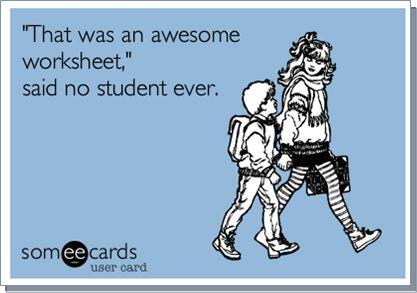
This meme might be funny, but it is also not true...but also it’s true


Speaking with a colleague the other day about weighing student feedback in course construction (prompted by the above meme), they remarked that in student surveys a few of their students requested more grammar worksheets. Should this student request be honoured, or is there more to the matter? I wrote this post to offer my thoughts.  

If one were to stack, one atop the other, every worksheet handed out to students in the last 30 years of Ontario FSL education, the pile would likely reach the moon. Similarly, stacking every Ontario citizen who went through the program, yet, did not speak French, or value language learning as a result of it, one might just reach the planet Mars. That’s, in part, because the teach + worksheet + test + repeat model hasn’t benefitted anglophone students in elementary and secondary second language programs. Peu importe the addition of the “activity” or “game” between teach and worksheet steps (though, it is a step in the right direction).

Consequently, the message conveyed in the above-pictured meme, can be particularly funny to FSL educators. It encapsulates our current understanding of (and pokes fun at) what schools and older curriculum got wrong about learning, and, specifically, language learning. While spot on in its reflection of the ethos, the meme is also factually inaccurate. Let me explain.

Students, like everyone, typically want to do well. That is to say, all things equal, if given the choice of two scenarios, whatever the subject matter, between an academically positive result and a negative result, students will choose the former. Moreover, whether actual learning has occurred or not, does not factor in at all. It does not matter if a positive result is actually tied to genuine learning. An A+ without learning is preferred over a D- with learning. I’ll avoid getting into the #TTGO debate at this point (spoiler: feedback trumps grades).

In FSL, vocab and verb conjugation worksheets have always provided an avenue for learners to achieve a positive result, and associated positive feelings, without actually providing them with an increase in practical language ability, beyond the ability to complete worksheets. Thus, it is no surprise that many students enjoy worksheets. In fact, it is just as unsurprising for me that I have heard, verbatim, students in my Core French classes say “that was an awesome worksheet” more than once!

This piece of student feedback, that some of my students want to do pencil and paper work, does not invalidate the evidence-based methodology outlined in the CEFR. It merely underscores the need for our students to unlearn a lot of the ineffective practices perpetuated for years in Ontario schools.

The dichotomy in modern education reform is most succinctly expressed as playing school vs. learning (paraphrased from this epic video by Prince Ea). By actively exploring and implementing CEFR practice in Core French classrooms, and focusing on spoken interaction and spoken production, we disrupt ineffective pedagogical mentalities (playing school), however well intentioned and comforting they seem to be.

This may sound extreme, but I equate statements like “I hate French”, “when am I ever going to use this?” and “that was an awesome worksheet” all as products of the same pedagogical mindset. They are calls to action to improve my practice by avoiding things that didn’t work that last time I tried.

In response to students who ask for more grammar worksheets, I would simply, and honestly, ask them to show me how sheets are helping them speak and act in another language. I’ll go with anything that works.   

If you got this far, please take the time to respond in the comments and tell me what you think. If you have an idea to share, consider writing your own blog post.

This post was written by Philippe Croteau.

About Philippe: Usually teaches grades 6,7 and 8 Core French in SCDSB public schools and loves it. He has a Twitter @pcroteauirt, where his opinions are his own. Philippe thinks F/E dictionaries are better than Word Reference and Bon Patron, because at least the dictionary will allow you to not learn French in the event of a power outage or Zombie apocalypse. He learned what adverbs were in University, and probably didn’t know what adjectives were, really, until teacher’s college. Speaks Japanese (B1), German (A1) on top of the usual ones. Also, he enjoys long walks on beaches and ice cream.  

Monday, August 29, 2016

Why My Students Use Google Translate (and, yours should too)

Welcome back CEFR Barrie Regional colleagues! I really should be engaged in about four different start up prep tasks right now, but thought I would take the time (procrastinate) to add some content to this blog. CEFR Regional Team, thanks for giving us an outlet for sharing “big ideas”. I look forward to seeing where the blog goes this school year.

The first week of school I am showing (or, reviewing with) my students how to use handheld devices to support their language learning. And, the first app I will ask them to download is Google Translate (GT). In my class, it not only drives language learning, but is the centerpiece to students learning how to learn and being cognisant of their learning. As importantly, for me,GT is a pedagogical touchstone. How students use this one tool in my classroom lets me know if I am sticking to the evidence-based principles of effective L2 pedagogy (CEFR). Let me explain.


Four years ago, all I knew about language translating software and websites was that students could input text in their native language, click a button, and have an assignment written in something resembling French. The nonsensical word order and erudite grammar was always a dead give away, and, the only thing more reliable than my ability to detect translated work, was another transgression coming across my desk (cart) within a week. I forbade its use.


Three years ago, I discovered that GT was available as an app for handheld devices. Since my last run-in with GT, it had evolved. It now allowed one to speak in one's native language, and provided an oral translation. No text. Moreover, a subsequent function was added which permitted one to simply point the camera at text in one language and displayed it on screen in an L2! CLICK HERE to see a video of it in action.


My students now had access to a tool that enhanced and accelerated their learning AND their metacognition. For example, one of the first tasks I assigned to students was to pair up with someone, learn how to say something (anything) in French, using the voice to voice function, record themselves saying it (NOT reading it), and come show me. The result was a pedagogical masterpiece worthy of a TPA (the old kind, where you could be “excellent”). Students learning what they wanted to learn (being themselves in French), coming to see me for feedback (while smiling!) and then going off to learn more without me telling them to! All the while, students were honing their skills, deciding on strategies that allowed them to learn oral first and only, and discarding unproductive habits.


A variety of high needs in a classroom tend to produce in one an “innovate or die” mindset. I found the GT Camera translate function to be vital in engaging struggling readers in tasks they would otherwise be disengaged (or, disengage themselves) from. I simply added the camera, imperfect as it can sometimes be, to their list of reading strategies. Essentially, the instruction is something like, “point your camera at this and see if you can figure out what it’s saying”. Its output gave enough cues to allow (and, engage) a student in the process of making meaning individually, or as part of a group. Scaffolding!


I no longer have students write things before they learn to say them, and I no longer have students read from a page pretending like they’ve learned how to say something. GT has fit into this new, and, I think, realistic paradigm. If something is handed in to me now, which I judge to be “not their work” (like the GT generated hot mess of yore), it more likely means something has to change about what I asked that student to do, or what that student expected L2 learning to be. Of which, both can and should take ownership. In this way, all tech integration, not only the GT tool, makes CEFR ideas a tangible reality in our classrooms.    


If you got this far, please take the time to respond in the comments and tell me what you think. If you have an idea to share, consider writing your own blog post.Imagine if we all did one of these!


This post was written by Philippe Croteau.

About Philippe: Usually teaches grades 6,7 and 8 Core French in SCDSB public schools and loves it. He has a Twitter @pcroteauirt, where his opinions are his own. Philippe thinks F/E dictionaries are better than Word Reference and Bon Patron, because at least the dictionary will allow you to not learn French in the event of a power outage or Zombie apocalypse. He learned what adverbs were in University, and probably didn’t know what adjectives were, really, until teacher’s college. Speaks Japanese (B1), German (A1) on top of the usual ones. Also, he enjoys long walks on beaches and ice cream.

Wednesday, June 15, 2016

Aujourd'hui c'est "The Amazing Race" à l'école Notre Dame, Bruce Grey Catholic District School Board.  Les profs de français cadre sont ensemble pour un enquête collaborative où ils travaillent avec les élèves pour ameliorer leurs compétences et confiances en orale.  17 profs ensemble pour planifier les centres différentes.  Une tâche pour chaque centre avec un compréhension orale et une production orale où les profs peuvent avoir les interactions avec les élèves. (niveau A1).

Wednesday, May 18, 2016


  • On cherche des apprenants ou lecteurs français qui peuvent lire nos blogues et commenter aux articles des élèves pour commencer une conversation. La classe est 9e/10e immersion et on écrit des blogues au sujet de nous-mêmes.   
  • http://mmehillyer.weebly.com/blogues-des-eleves.html