Colleagues,
I spent my morning using the audio-lingua and QRstuff.com sites to create this sheet of QR codes linked to self-introductions in French. I thought I would share before heading out to class. CLICK HERE to access the document.
It is a sheet of ten QR codes. When scanned with a QR reader (a free app that all your students know about) each one links to a short voice recording of a non-professional French person talking about themselves and their lives.
The doc is rough and "not ready to be shared yet" but it is functional and you can make a copy and dress it up as you see fit.
I am asking my students today to listen and note what they know about each person. But, I wonder what other things an FSL colleague would do with this in their hands. Let me know in the comments!
Thanks to team who shared audio-lingua with us!
Also, here's a video of me showing my colleague how to make QR codes
Philippe
Thursday, May 4, 2017

Thursday, April 20, 2017
April session review
Our Barrie CEFR region is a group of dedicated FSL educators that are passionate about creating the best educational experience for students. This year we focused on the 4 components of the CEFR and reflected on where our instruction was at that moment. Many ideas and resources were shared with educators from across the region. The following is a growing list of resources discussed in our groups.
Provides over 600 french audio clips that can be organized based on CEFR level, gender and age of the speakers. You can even copy the link and share it with your students. Here’s an example
Cut and paste any text and have it read back to you. The speed can even be adjusted to change the pace.
This blog has numerous recordings of interviews with students ranging from levels A1-B2. It includes questions, quizzes and transcripts of the interviews as well.
This blog from Belgium has a variety of Graphic texts in French.
A fun tool for adding audio to images. Just upload an image and add a mouth to make it appear like someone is speaking.
If you have any other great FSL resources that reflect the CEFR, please share in the comment box.
Wednesday, April 12, 2017
2002 called. They want their blog back!
The best ideas were always first shared as bad ideas.
Colleagues, if you are reading this on April 12, 2017, welcome to the final meet up for the year of the Barrie CEFR team. Enjoy the learning today! I am the bearded man off to the side of the room managing blog and twitter updates for this session. If I do not get the chance to speak much, I would like to take this opportunity to plug our blog.
When blogs started off, they were places where individuals could post, discuss and often argue about big ideas. As blogs took off as fora for new and interesting ideas, they proliferated on the internet, and eventually evolved into many different shapes and sizes. The line blurred between what differentiates a website and a blog.
The #CEFRBarrie blog is, in spirit, a classic blog. Of course, we can, and should, use it as a platform to share our resources and ideas with colleagues as we learn about the CEFR, but I think it is even better for the sharing of BIG ideas and to track our learning and mindsets in the BarrieCEFR group! It is a place where we can post our thoughts, whether philosophical musings about L2 pedagogy or blunt opinions on curriculum. As with any forum, the idea is that we can get feedback from other professionals to refine our own thinking beyond our face to face meetings.
Going forward, fellow #BarrieCEFR teacher/learners, use this blog to share your thoughts and ideas, and don't be concerned about your idea being incomplete or "not ready yet". Our principal goal should be to collaborate and make our thinking, and our students' learning better by consequence of our participation in this conversation.
Bonne journée!
P.S. use this hashtag to share your learning today on twitter! #cefrbarrie
Colleagues, if you are reading this on April 12, 2017, welcome to the final meet up for the year of the Barrie CEFR team. Enjoy the learning today! I am the bearded man off to the side of the room managing blog and twitter updates for this session. If I do not get the chance to speak much, I would like to take this opportunity to plug our blog.
When blogs started off, they were places where individuals could post, discuss and often argue about big ideas. As blogs took off as fora for new and interesting ideas, they proliferated on the internet, and eventually evolved into many different shapes and sizes. The line blurred between what differentiates a website and a blog.
The #CEFRBarrie blog is, in spirit, a classic blog. Of course, we can, and should, use it as a platform to share our resources and ideas with colleagues as we learn about the CEFR, but I think it is even better for the sharing of BIG ideas and to track our learning and mindsets in the BarrieCEFR group! It is a place where we can post our thoughts, whether philosophical musings about L2 pedagogy or blunt opinions on curriculum. As with any forum, the idea is that we can get feedback from other professionals to refine our own thinking beyond our face to face meetings.
Going forward, fellow #BarrieCEFR teacher/learners, use this blog to share your thoughts and ideas, and don't be concerned about your idea being incomplete or "not ready yet". Our principal goal should be to collaborate and make our thinking, and our students' learning better by consequence of our participation in this conversation.
Bonne journée!
P.S. use this hashtag to share your learning today on twitter! #cefrbarrie
Wednesday, February 22, 2017
Bienvenue!

Heureuses de vous acceullir aujourd'hui pour une journée d'apprentissage et de réseautage.

Tuesday, October 11, 2016
This meme might be funny, but it is also not true...but also it’s true
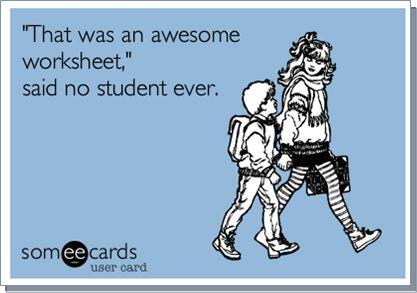
Speaking with a colleague the other day about weighing student feedback in course construction (prompted by the above meme), they remarked that in student surveys a few of their students requested more grammar worksheets. Should this student request be honoured, or is there more to the matter? I wrote this post to offer my thoughts.
If one were to stack, one atop the other, every worksheet handed out to students in the last 30 years of Ontario FSL education, the pile would likely reach the moon. Similarly, stacking every Ontario citizen who went through the program, yet, did not speak French, or value language learning as a result of it, one might just reach the planet Mars. That’s, in part, because the teach + worksheet + test + repeat model hasn’t benefitted anglophone students in elementary and secondary second language programs. Peu importe the addition of the “activity” or “game” between teach and worksheet steps (though, it is a step in the right direction).
Consequently, the message conveyed in the above-pictured meme, can be particularly funny to FSL educators. It encapsulates our current understanding of (and pokes fun at) what schools and older curriculum got wrong about learning, and, specifically, language learning. While spot on in its reflection of the ethos, the meme is also factually inaccurate. Let me explain.
Students, like everyone, typically want to do well. That is to say, all things equal, if given the choice of two scenarios, whatever the subject matter, between an academically positive result and a negative result, students will choose the former. Moreover, whether actual learning has occurred or not, does not factor in at all. It does not matter if a positive result is actually tied to genuine learning. An A+ without learning is preferred over a D- with learning. I’ll avoid getting into the #TTGO debate at this point (spoiler: feedback trumps grades).
In FSL, vocab and verb conjugation worksheets have always provided an avenue for learners to achieve a positive result, and associated positive feelings, without actually providing them with an increase in practical language ability, beyond the ability to complete worksheets. Thus, it is no surprise that many students enjoy worksheets. In fact, it is just as unsurprising for me that I have heard, verbatim, students in my Core French classes say “that was an awesome worksheet” more than once!
This piece of student feedback, that some of my students want to do pencil and paper work, does not invalidate the evidence-based methodology outlined in the CEFR. It merely underscores the need for our students to unlearn a lot of the ineffective practices perpetuated for years in Ontario schools.
The dichotomy in modern education reform is most succinctly expressed as playing school vs. learning (paraphrased from this epic video by Prince Ea). By actively exploring and implementing CEFR practice in Core French classrooms, and focusing on spoken interaction and spoken production, we disrupt ineffective pedagogical mentalities (playing school), however well intentioned and comforting they seem to be.
This may sound extreme, but I equate statements like “I hate French”, “when am I ever going to use this?” and “that was an awesome worksheet” all as products of the same pedagogical mindset. They are calls to action to improve my practice by avoiding things that didn’t work that last time I tried.
In response to students who ask for more grammar worksheets, I would simply, and honestly, ask them to show me how sheets are helping them speak and act in another language. I’ll go with anything that works.
If you got this far, please take the time to respond in the comments and tell me what you think. If you have an idea to share, consider writing your own blog post.
This post was written by Philippe Croteau.
About Philippe: Usually teaches grades 6,7 and 8 Core French in SCDSB public schools and loves it. He has a Twitter @pcroteauirt, where his opinions are his own. Philippe thinks F/E dictionaries are better than Word Reference and Bon Patron, because at least the dictionary will allow you to not learn French in the event of a power outage or Zombie apocalypse. He learned what adverbs were in University, and probably didn’t know what adjectives were, really, until teacher’s college. Speaks Japanese (B1), German (A1) on top of the usual ones. Also, he enjoys long walks on beaches and ice cream.
Monday, August 29, 2016
Why My Students Use Google Translate (and, yours should too)
Welcome back CEFR Barrie Regional colleagues! I really should be engaged in about four different start up prep tasks right now, but thought I would take the time (procrastinate) to add some content to this blog. CEFR Regional Team, thanks for giving us an outlet for sharing “big ideas”. I look forward to seeing where the blog goes this school year.
The first week of school I am showing (or, reviewing with) my students how to use handheld devices to support their language learning. And, the first app I will ask them to download is Google Translate (GT). In my class, it not only drives language learning, but is the centerpiece to students learning how to learn and being cognisant of their learning. As importantly, for me,GT is a pedagogical touchstone. How students use this one tool in my classroom lets me know if I am sticking to the evidence-based principles of effective L2 pedagogy (CEFR). Let me explain.
The first week of school I am showing (or, reviewing with) my students how to use handheld devices to support their language learning. And, the first app I will ask them to download is Google Translate (GT). In my class, it not only drives language learning, but is the centerpiece to students learning how to learn and being cognisant of their learning. As importantly, for me,GT is a pedagogical touchstone. How students use this one tool in my classroom lets me know if I am sticking to the evidence-based principles of effective L2 pedagogy (CEFR). Let me explain.
Four years ago, all I knew about language translating software and websites was that students could input text in their native language, click a button, and have an assignment written in something resembling French. The nonsensical word order and erudite grammar was always a dead give away, and, the only thing more reliable than my ability to detect translated work, was another transgression coming across my desk (cart) within a week. I forbade its use.
Three years ago, I discovered that GT was available as an app for handheld devices. Since my last run-in with GT, it had evolved. It now allowed one to speak in one's native language, and provided an oral translation. No text. Moreover, a subsequent function was added which permitted one to simply point the camera at text in one language and displayed it on screen in an L2! CLICK HERE to see a video of it in action.
My students now had access to a tool that enhanced and accelerated their learning AND their metacognition. For example, one of the first tasks I assigned to students was to pair up with someone, learn how to say something (anything) in French, using the voice to voice function, record themselves saying it (NOT reading it), and come show me. The result was a pedagogical masterpiece worthy of a TPA (the old kind, where you could be “excellent”). Students learning what they wanted to learn (being themselves in French), coming to see me for feedback (while smiling!) and then going off to learn more without me telling them to! All the while, students were honing their skills, deciding on strategies that allowed them to learn oral first and only, and discarding unproductive habits.
A variety of high needs in a classroom tend to produce in one an “innovate or die” mindset. I found the GT Camera translate function to be vital in engaging struggling readers in tasks they would otherwise be disengaged (or, disengage themselves) from. I simply added the camera, imperfect as it can sometimes be, to their list of reading strategies. Essentially, the instruction is something like, “point your camera at this and see if you can figure out what it’s saying”. Its output gave enough cues to allow (and, engage) a student in the process of making meaning individually, or as part of a group. Scaffolding!
I no longer have students write things before they learn to say them, and I no longer have students read from a page pretending like they’ve learned how to say something. GT has fit into this new, and, I think, realistic paradigm. If something is handed in to me now, which I judge to be “not their work” (like the GT generated hot mess of yore), it more likely means something has to change about what I asked that student to do, or what that student expected L2 learning to be. Of which, both can and should take ownership. In this way, all tech integration, not only the GT tool, makes CEFR ideas a tangible reality in our classrooms.
If you got this far, please take the time to respond in the comments and tell me what you think. If you have an idea to share, consider writing your own blog post.Imagine if we all did one of these!
This post was written by Philippe Croteau.
About Philippe: Usually teaches grades 6,7 and 8 Core French in SCDSB public schools and loves it. He has a Twitter @pcroteauirt, where his opinions are his own. Philippe thinks F/E dictionaries are better than Word Reference and Bon Patron, because at least the dictionary will allow you to not learn French in the event of a power outage or Zombie apocalypse. He learned what adverbs were in University, and probably didn’t know what adjectives were, really, until teacher’s college. Speaks Japanese (B1), German (A1) on top of the usual ones. Also, he enjoys long walks on beaches and ice cream.
Subscribe to:
Posts (Atom)